
January 10, 2024 Update
Mistral released an API-only, experimental variant of Mixtral, simply titled Mistral Medium &mdas h; while no model data or facts have been shared, we now have benchmark data showing developers prefer Mistral Medium outputs over all Anthropic models.
MT-Bench Leaderboard
| Model | Arena Elo rating | MT-bench (score) | MMLU | License |
|---|---|---|---|---|
| GPT-4-Turbo | 1249 | 9.32 | — | Proprietary |
| GPT-4-0314 | 1190 | 8.96 | 86.4 | Proprietary |
| Mistral Medium | 1150 | 8.61 | 75.3 | Proprietary |
| Claude-1 | 1149 | 7.9 | 77 | Proprietary |
| Claude-2.0 | 1131 | 8.06 | 78.5 | Proprietary |
| Mixtral-8x7b-Instruct-v0.1 | 1123 | 8.3 | 70.6 | Apache 2.0 |
| Gemini Pro (Dev) | 1120 | — | 71.8 | Proprietary |
| Claude-2.1 | 1119 | 8.18 | — | Proprietary |
| GPT-3.5-Turbo-0613 | 1116 | 8.39 | — | Proprietary |
| Claude-Instant-1 | 1110 | 7.85 | 73.4 | Proprietary |
Historical Note and Current Arena Context
In January 2024, Mistral released an API-only, experimental variant of Mixtral called Mistral Medium. No architecture details were disclosed for that model.
The table below places Mixtral 8x7B in the official Arena style-controlled text data pinned to its July 14, 2026 revision. Arena ratings reflect anonymous human pairwise preferences adjusted for response length and Markdown formatting.
| Rank | Model | Context | Arena rating | 95% interval | Votes |
|---|---|---|---|---|---|
| 1 | claude-fable-5 | Overall leader | 1507.5 | 1500.1–1515.0 | 7,959 |
| 83 | mistral-medium-3.5 | Highest-ranked Mistral entry | 1427.2 | 1420.6–1433.8 | 11,039 |
| 307 | mixtral-8x7b-instruct-v0.1 | Model documented on this page | 1196.3 | 1192.0–1200.6 | 73,503 |
Archived peer comparison (January 10, 2024 repository snapshot)
The following release-era table is restored in full from this page's January 10, 2024 revision. It preserves the contemporary peer context for Mixtral 8x7B and the experimental Mistral Medium API model.
| Model | Arena Elo rating | MT-Bench score | MMLU | License |
|---|---|---|---|---|
| GPT-4-Turbo | 1249 | 9.32 | — | Proprietary |
| GPT-4-0314 | 1190 | 8.96 | 86.4 | Proprietary |
| Mistral Medium | 1150 | 8.61 | 75.3 | Proprietary |
| Claude-1 | 1149 | 7.9 | 77 | Proprietary |
| Claude-2.0 | 1131 | 8.06 | 78.5 | Proprietary |
| Mixtral-8x7b-Instruct-v0.1 | 1123 | 8.3 | 70.6 | Apache 2.0 |
| Gemini Pro (Dev) | 1120 | — | 71.8 | Proprietary |
| Claude-2.1 | 1119 | 8.18 | — | Proprietary |
| GPT-3.5-Turbo-0613 | 1116 | 8.39 | — | Proprietary |
| Claude-Instant-1 | 1110 | 7.85 | 73.4 | Proprietary |
These columns are separate measurements: the archived Arena Elo values estimate human pairwise preference, MT-Bench uses fixed multi-turn prompts and an LLM judge, and MMLU measures multiple-choice knowledge and reasoning. Their units and protocols cannot be combined into one score. The archived revision does not identify the exact Arena data revision, MT-Bench judge model and prompt configuration, or MMLU shot and scoring setup, so the rows should not be compared directly with the July 2026 Arena snapshot or treated as a reproducible cross-metric ranking.
Mixtral 8x7B is a legacy model in this contemporary ranking and does not represent Mistral's current product capabilities. Its release-era MT-Bench and MMLU results remain useful as historical evidence about the model at launch, but they should not be compared directly with Arena's current human-preference ratings.
What is the Mistral "Mixtral" 8x7B 32k?
The Mistral "Mixtral" 8x7B 32k model is a state-of-the-art LLM developed by Mistral AI, designed as a Sparse Mixture of Experts (SMoE) model. Mixtral employs a sparse mixture-of-experts network, functioning as a decoder-only model.
Current context: This describes Mixtral's position at its December 2023 release rather than a current frontier ranking.
The model uses a feedforward block that selects from 8 unique parameter groups, and a router network determines two groups to process each token, merging their outputs. This approach allows Mixtral to maintain a high parameter count (46.7B total) while optimizing for cost and latency, using a per-token efficiency equivalent to a 12.9B model.
Mixtral surpasses Llama 2 70B in most benchmarks and offers six times the inference speed, making it the leading open-weight model in terms of cost-performance balance.
Mixtral 8x7B competes with or exceeds OpenAI GPT-3.5 on various benchmarks, and Mixtral outputs are preferred by users over Anthropic Claude 2.1, OpenAI GPT-3.5-Turbo, Google Gemini Pro, and 01 Yi-34B.
Current context: These performance and preference claims describe release-era benchmarks and Arena results, not current model capabilities.
Key Features of Mixtral 8x7B:
- Supports a 32k token context for extensive data handling
- Multilingual capabilities in English, French, Italian, German, and Spanish
- Superior code generation performance
- Instruction-following model with an 8.3 MT-Bench score
- The model is trained on open web data
- simultaneous expert and router development
- Competitive with both Llama 2 70B and GPT-3.5 across various benchmarks
Current context: The code, MT-Bench, and competitor statements in this launch-era list should be interpreted under their original benchmark protocols.
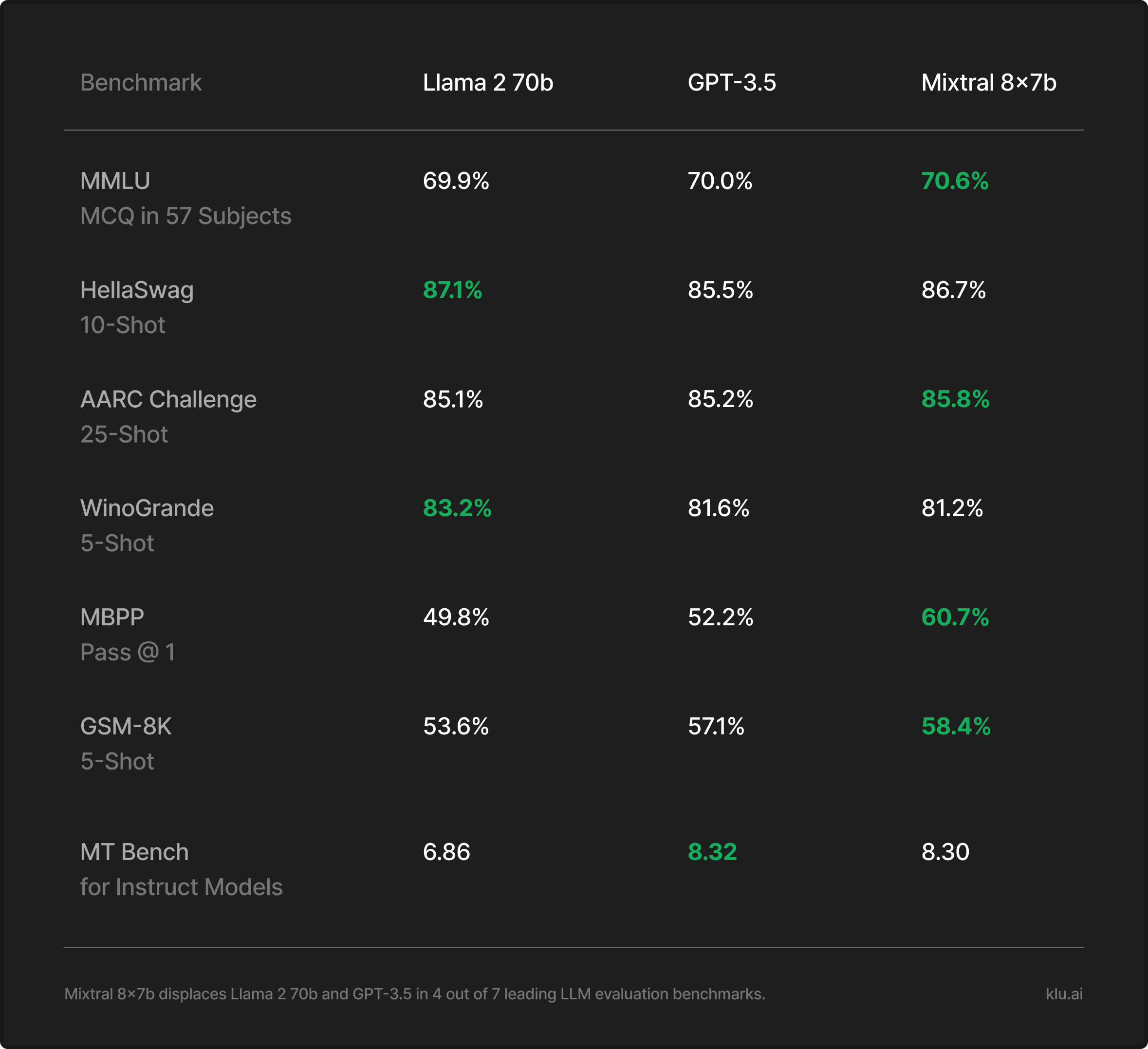
Mixtral 8x7b has a total of 56 billion parameters, supports a 32k context window, and displaces both Meta Llama 2 and OpenAI GPT-3.5 in 4 out of 7 leading LLM benchmarks. The Mixtral 8x7B model include support for 32k tokens, which allows it to handle extensive contexts, and it has demonstrated better code generation capabilities. It has been shown to match or outperform GPT-3.5 on most standard benchmarks. The model is also noted for its truthfulness and reduced bias, as indicated by its performance on benchmarks like TruthfulQA.
Current correction: Mixtral has 46.7 billion total parameters, with 12.9 billion active per token. The benchmark claims above are release-era results.
Current deployment context: Quantized GGUF versions typically need at least 25–30GB of memory, while full-precision inference benefits from 64GB or more of unified/system memory or a multi-GPU setup. Actual requirements vary by quantization and runtime.
Mixtral 8x7B is Mistral AI's second Large Language Model (LLM) and is licensed under Apache 2.0, making its weights openly available. It offers a 6x faster inference rate compared to Llama 2 70B and is considered the strongest open-weight model with a permissive license. The model is available in multiple languages, including French, German, Spanish, Italian, and English, and has been fine-tuned for instructed tasks.
Current context: The speed and strongest-model wording reflects Mixtral's release-era positioning.
Developers can access the Mixtral 8x7B model through various platforms, including the Klu.ai platform and Vercel's demo, which allows for comparison with other models like Meta LLaMA 2 70B. For those who prefer local usage, LM Studio supports offline model usage on various operating systems.
Mistral AI has positioned the Mixtral 8x7B model as a transformative force in the AI landscape, with its combination of cutting-edge computing architecture and sophisticated algorithms. The model's release represents a significant step towards commercializing AI innovations and making advanced AI models more accessible to the developer community.
Mistral-8x7B, an upgrade from Mistral-7B-v0.1, offers enhanced text understanding and generation, making it ideal for chat, writing, and communication tasks. It is designed to be powerful and fast, adaptable to many use cases, and supports multiple languages and code. However, due to its large size, it may not be suitable for running on a home GPU.
Current context: These use and deployment claims describe the release-era model; memory feasibility depends on precision, quantization, runtime, and hardware.
The model is a high-quality, sparse mixture of experts model (SMoE) with open weights and is licensed under Apache. It has been optimized through supervised fine-tuning and direct preference optimization (DPO) for careful instruction following.
Key features of this model include:
-
Architecture — Mistral 8x7B uses a transformer architecture, with 8 experts, utilizing 2 experts at inference time.
-
Attention Mechanisms — The model employs grouped-query attention for quick inference and sliding window attention for reasoning.
-
Size — The 8x7B model has 8 experts, each with 7 billion parameters, resulting in a total of 56 billion parameters.
Current correction: The model has 46.7 billion total parameters and 12.9 billion active per token due to sparse routing.
From Mistral's press release:
Current context: This quotation preserves Mistral's release wording. Its benchmark and endpoint statements are historical rather than current guidance.
The Mixtral 8x7B 32k model is a significant advancement in the field of AI and large language models, offering improved performance and efficiency compared to its predecessors. The official model code is not yet available, but frontier research labs and startups started implementing versions of the model.
Current context: Official model weights and reference implementations were subsequently released by Mistral AI, and many research labs and startups have built inference and fine-tuning implementations.
Mistral announced additional details about the model on December 11, 2023, including a prototype model with superior benchmarks. More information can be found on their official news page. As part of this announcement, Mistral has launched their model platform, which hosts the Mistral 7b (tiny), Mixtral 8x7b (small), and an undisclosed, more performant prototype model (medium).
Below is the stock model config.
{
    "dim": 4096,
    "n_layers": 32,
    "head_dim": 128,
    "hidden_dim": 14336,
    "n_heads": 32,
    "n_kv_heads": 8,
    "norm_eps": 1e-05,
    "vocab_size": 32000,
    "moe": {
        "num_experts_per_tok": 2,
        "num_experts": 8
    }
}
Official Mistral Benchmarks for Mixtral 8x7b
Mistral released official benchmarks for Mixtral 8x7b across comparable models, including OpenAI GPT-3.5 and Meta Llama 2.
The Mixtral 8x7B model shows strong performance across a range of benchmarks, often outperforming the Llama models on tasks that measure understanding and reasoning, such as MMLU, HellaSwag, ARC Challenge, and WinoGrande.
Current context: These are Mistral's release-era comparisons against models available at the time.
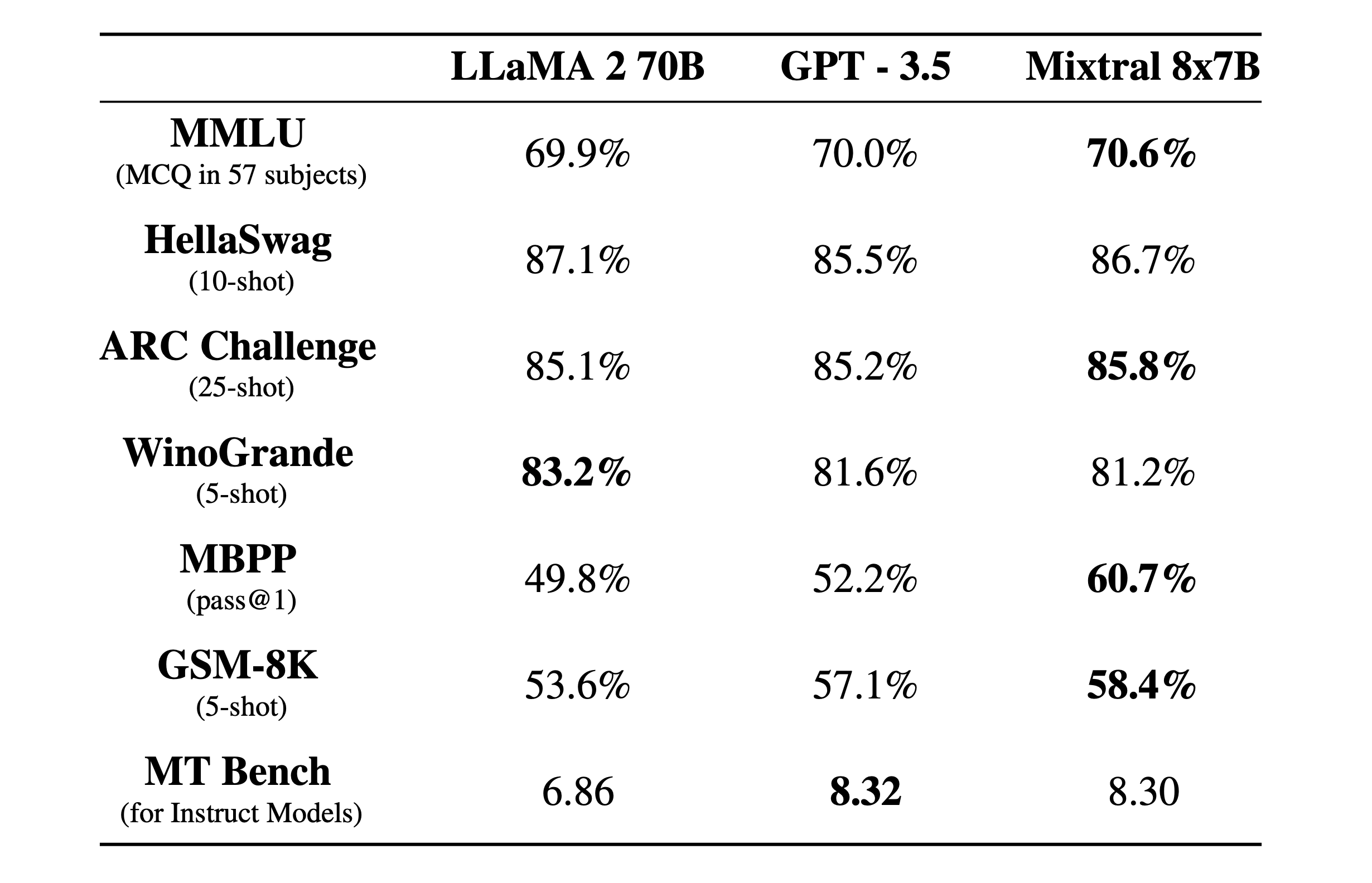
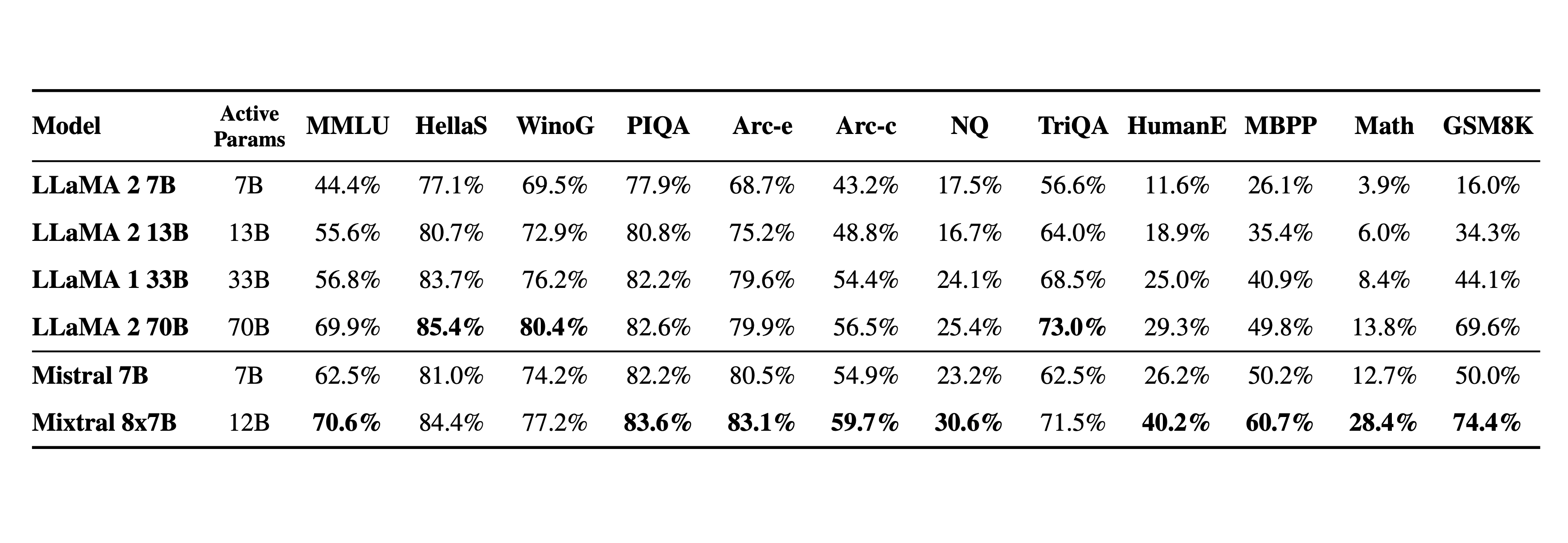
Overall, the Mixtral 8x7B model appears to be a robust and capable model, often outperforming or matching the benchmarks set by Llama models, especially in multilingual understanding and bias measurements. Mixtral 8x7B's performance indicates its potential as a leading choice for tasks requiring detailed understanding and generation.
Current context: This conclusion describes the release-era benchmark set rather than current model standings.
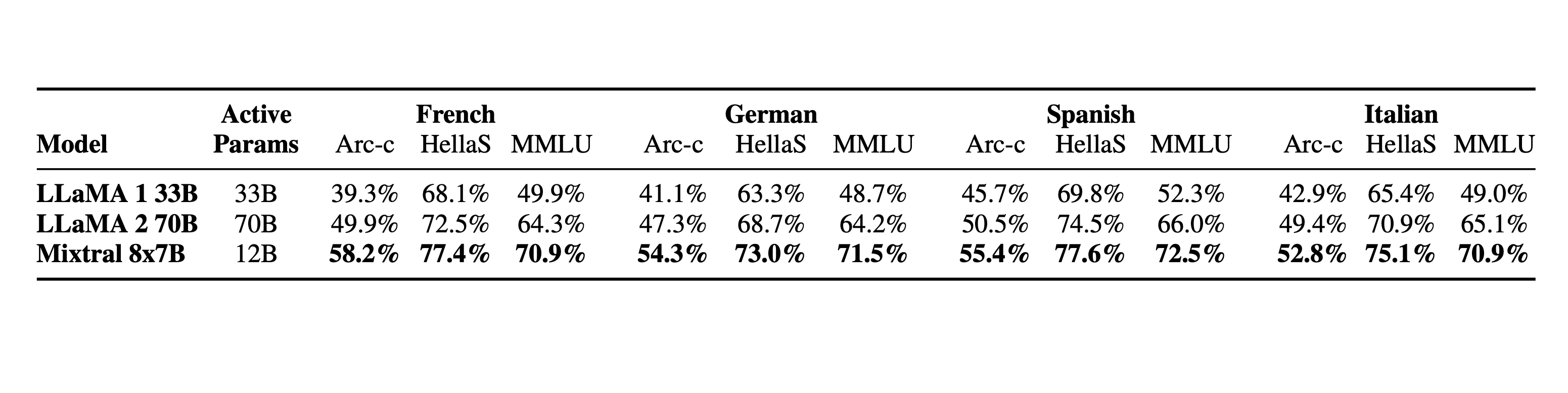
Mixtral 8x7B exhibits superior multilingual capabilities, outperforming Llama models in Spanish, French, German, and Italian on the MMLU (Multiple-Choice Questions in 57 Subjects) test. Its consistent high performance across different languages, particularly in the Hellas benchmarks, underscores its robust multilingual proficiency.
Current context: The comparison is limited to the release-era Llama models and evaluation setup shown.
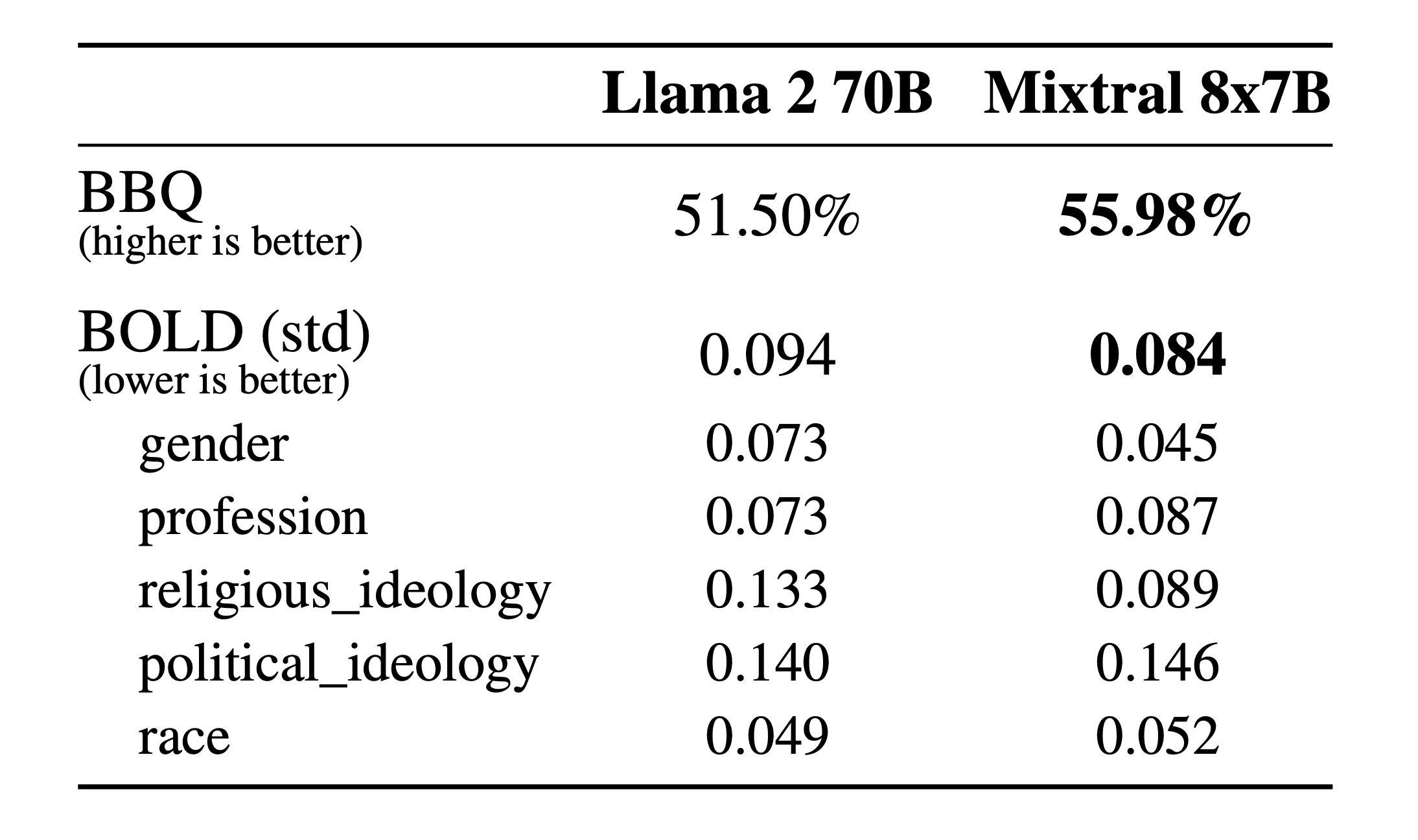
The Mixtral 8x7B model has lower BOLD (Bias in Open-ended Language generation Datasets) standard deviation scores, indicating it may generate less biased text across categories like gender, profession, religious ideology, political ideology, and race. Particularly, it shows less gender and race bias compared to Llama 2 70B, which is an important consideration for models deployed in diverse and inclusive environments.
Current context: This is a release-era BOLD comparison with Llama 2 70B, not a general safety guarantee.
MMLU 5-Shot Benchmark
Early community benchmarks place Mistral 8x7b higher than Open GPT-3.5 and near Google Gemini Pro. We expect fine-tuned variations to gain 5-10 more points.
Current context: This was a release-era expectation, not a verified universal fine-tuning gain.
| Model | MMLU Score |
|---|---|
| GPT-4 | 86.4 |
| Gemini Ultra | 83.7 |
| Mistral Medium | 75.3 |
| Gemini Pro | 71.8 |
| Mistral 8x7b | 71.3 |
| GPT-3.5 | 70 |
| Mistral 7b | 60.1 |
Community Benchmark
| Model | Arena Elo rating | MT-bench (score) | MMLU | License |
|---|---|---|---|---|
| Mixtral-8x7b-Instruct-v0.1 | 1123 | 8.3 | 70.6 | Apache 2.0 |
The team behind OpenCompass published comprehensive, third-party benchmarks of the Mixtral 8x7b model, comparing it to Mistral 7b, Llama 2 70b, DeepSeek 67b, and Qwen 72b.
| Eval | Mode | Mistral-7B | Mixtral-8x7B | Llama2-70B | DeepSeek-67B-Base | Qwen-72B |
|---|---|---|---|---|---|---|
| MMLU | PPL | 64.1 | 71.3 | 69.7 | 71.9 | 77.3 |
| BIG-Bench-Hard | GEN | 56.7 | 67.1 | 64.9 | 71.7 | 63.7 |
| GSM-8K | GEN | 47.5 | 65.7 | 63.4 | 66.5 | 77.6 |
| MATH | GEN | 11.3 | 22.7 | 12.0 | 15.9 | 35.1 |
| HumanEval | GEN | 27.4 | 32.3 | 26.2 | 40.9 | 33.5 |
| MBPP | GEN | 38.6 | 47.8 | 39.6 | 55.2 | 51.6 |
| ARC-c | PPL | 74.2 | 85.1 | 78.3 | 86.8 | 92.2 |
| ARC-e | PPL | 83.6 | 91.4 | 85.9 | 93.7 | 96.8 |
| CommonSenseQA | PPL | 67.4 | 70.4 | 78.3 | 70.7 | 73.9 |
| NaturalQuestion | GEN | 24.6 | 29.4 | 34.2 | 29.9 | 27.1 |
| TrivialQA | GEN | 56.5 | 66.1 | 70.7 | 67.4 | 60.1 |
| HellaSwag | PPL | 78.9 | 82.0 | 82.3 | 82.3 | 85.4 |
| PIQA | PPL | 81.6 | 82.9 | 82.5 | 82.6 | 85.2 |
| SIQA | GEN | 60.2 | 64.3 | 64.8 | 62.6 | 78.2 |
| Dataset | Version | Metric | Mode | Mixtral-8x7b-32k |
|---|---|---|---|---|
| MMLU | - | naive_average | PPL | 71.34 |
| ARC-c | 2ef631 | accuracy | PPL | 85.08 |
| ARC-e | 2ef631 | accuracy | PPL | 91.36 |
| BoolQ | 314797 | accuracy | PPL | 86.27 |
| commonsense_qa | 5545e2 | accuracy | PPL | 70.43 |
| triviaqa | 2121ce | score | GEN | 66.05 |
| nq | 2121ce | score | GEN | 29.36 |
| openbookqa_fact | 6aac9e | accuracy | PPL | 85.40 |
| AX_b | 6db806 | accuracy | PPL | 48.28 |
| AX_g | 66caf3 | accuracy | PPL | 48.60 |
| hellaswag | a6e128 | accuracy | PPL | 82.01 |
| piqa | 0cfff2 | accuracy | PPL | 82.86 |
| siqa | e8d8c5 | accuracy | PPL | 64.28 |
| math | 265cce | accuracy | GEN | 22.74 |
| gsm8k | 1d7fe4 | accuracy | GEN | 65.66 |
| openai_humaneval | a82cae | humaneval_pass@1 | GEN | 32.32 |
| mbpp | 1e1056 | score | GEN | 47.80 |
| bbh | - | naive_average | GEN | 67.14 |
How to Access Mistral 8x7B 32k?
You can find the original Torrent Magnet link drop on X / Twitter.
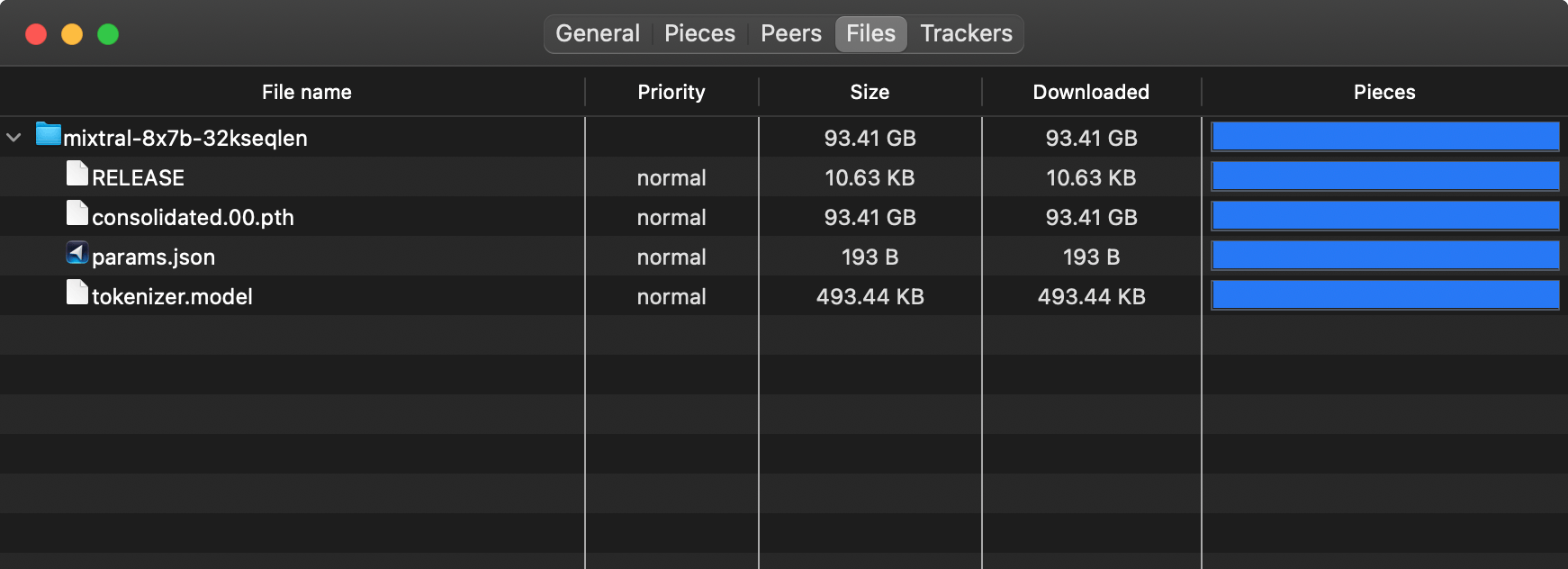
If you don't want to use the Torrent, the Mistral "Mixtral" 8x7B 32k model can be found on the HuggingFace Model Hub, where you can directly download or use it for inference:
Current access context: The model is also available through Mistral AI's official model platform and official weights on the HuggingFace Model Hub. The links above preserve the original release-era distribution path and community uploads.
Testing the model
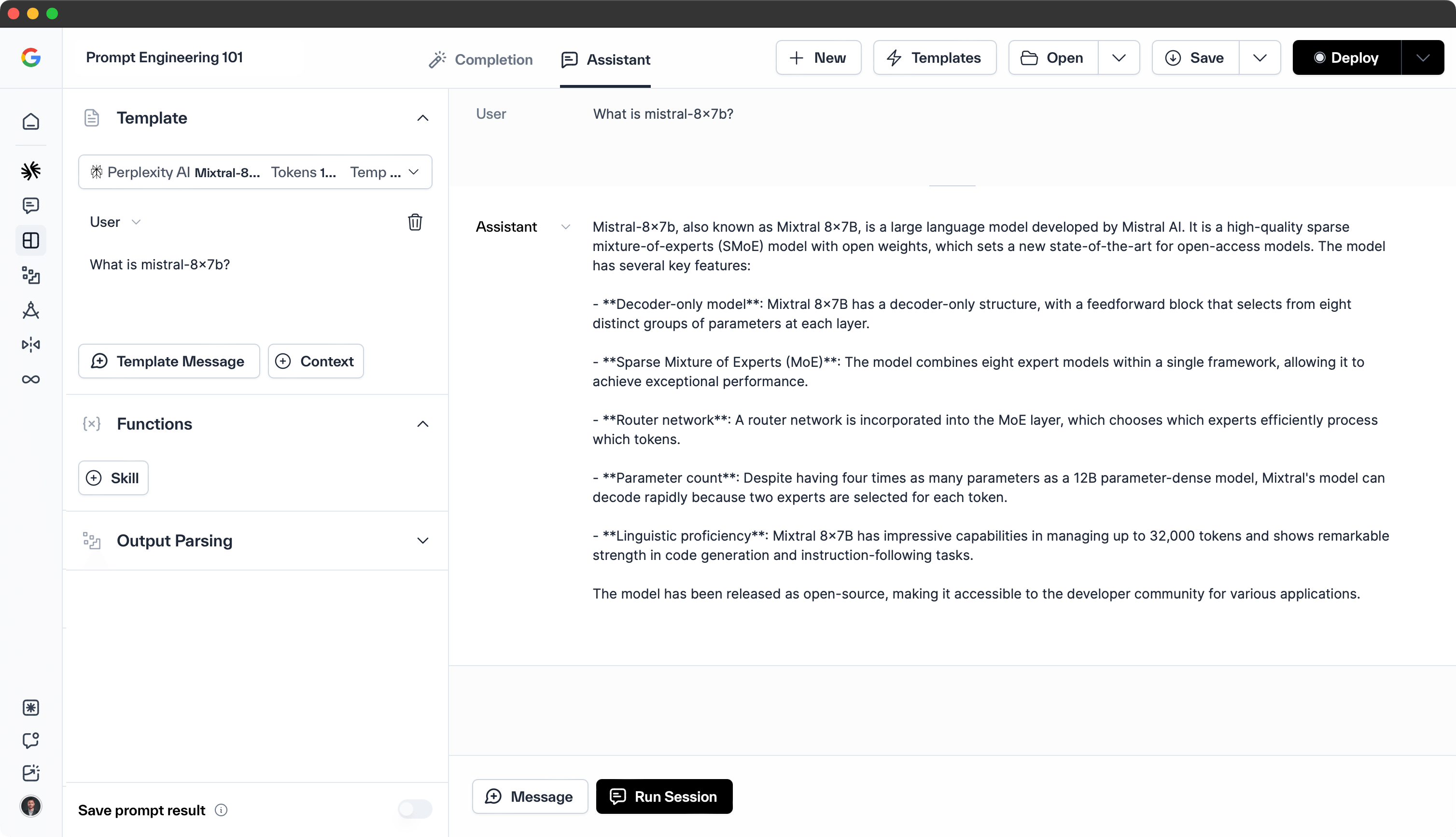
You can test the new model on several platforms:
Please note that the information provided is based on the current state of the Mistral 8x7B 32k model. We expect this to rapidly evolve over the next week.
Current context: Platform availability changes over time; check each provider's documentation for current status.
What are the key features of Mistral 8x7B 32k?
The Mistral "Mixtral" 8x7B 32k model is a state-of-the-art artificial intelligence model developed by Mistral AI. It is a Sparse Mixture of Experts (SMoE) model, characterized by its advanced computational architecture, which includes high-speed parallel processing capabilities and sophisticated data handling functions.
Current context: The state-of-the-art description reflects the model's release period.
Key features of the Mixtral 8x7B model include:
-
Support for 32k tokens — This allows the model to handle extensive contexts, making it capable of understanding and generating complex text.
-
Advanced code generation capabilities — The model has demonstrated better code generation capabilities, making it a valuable tool for tasks where understanding and solving algorithmic challenges are crucial.
-
Performance — The model matches or outperforms GPT-3.5 on most standard benchmarks, indicating its high performance and efficiency.
Current context: This is a release-era benchmark comparison.
-
Open-source — The model is licensed under Apache 2.0, making its weights openly available. This fosters responsible AI usage and allows developers to modify and build upon the model.
-
Multilingual support — The model supports multiple languages, including French, German, Spanish, Italian, and English, making it versatile for various applications.
-
Efficiency — The model offers a 6x faster inference rate compared to Llama 2 70B, making it one of the most efficient models available.
Current context: This is Mistral's release-era comparison with Llama 2 70B.
-
Fine-tuning for instructed tasks — The model has been fine-tuned for instructed tasks, enhancing its performance for specific applications.
What is the difference between Mistral "Mixtral" 8x7b 32k model and Mistral 7b model?
The Mistral "Mixtral" 8x7B 32k and Mistral 7B models, both from Mistral AI, differ significantly. Mixtral 8x7B employs a Sparse Mixture of Experts (SMoE) architecture, integrating eight specialized models to enhance performance, whereas Mistral 7B lacks this structure. Consequently, Mixtral 8x7B surpasses Mistral 7B in benchmarks, including multilingual tasks, and supports a broader context with 32k tokens compared to Mistral 7B's effective 8k due to its sliding window implementation. However, Mixtral 8x7B's advanced capabilities require more resources—64GB of RAM and dual GPUs—unlike Mistral 7B's modest 24GB RAM and single GPU setup, leading to higher operational costs. Additionally, Mixtral 8x7B benefits from extensive fine-tuning across multiple datasets, contributing to its superior performance.
Current context: The benchmark comparison is release-era, and the hardware figures are examples rather than fixed requirements. Actual memory and GPU needs vary by quantization, framework, and inference settings.
How does the performance of mistral "mixtral" 8x7b 32k model compare to other models?
The Mistral "Mixtral" 8x7B model, with 45 billion parameters, achieves high efficiency by utilizing only 12 billion parameters per token. This design enables it to operate at the speed and cost of a smaller model while maintaining the capability to process a 32k token context in multiple languages, including English, French, Italian, and German. Its performance rivals or exceeds that of Llama 2 70B and GPT-3.5 across various benchmarks, offering six times faster inference than Llama 2 70B, making it the most potent model available under a permissive license.
Mixtral 8x7B stands out for its truthfulness, scoring 73.9% on the TruthfulQA benchmark, and exhibits reduced bias, particularly in the BOLD benchmark. Its advanced code generation capabilities also surpass GPT-3.5 in standard benchmarks. While Mixtral 8x7B's resource requirements exceed those of Mistral 7B, necessitating more RAM and GPUs, its user-tunable nature allows for deployment on sufficiently equipped systems. Overall, Mixtral 8x7B's combination of efficiency, multilingual support, and superior code generation positions it as an optimal choice for diverse applications.
Current correction: Mixtral has 46.7 billion total parameters and 12.9 billion active per token. The performance, TruthfulQA, BOLD, and code claims describe release-era evaluations; hardware needs vary by deployment configuration.
What are the Use Cases of Mistral 8x7B 32k?
The Mistral 8x7B 32k model is a powerful and efficient large language model (LLM) that has various use cases. Some of the potential applications include:
-
Natural language processing — The model can be used for various natural language processing tasks, such as text classification, sentiment analysis, and text generation.
-
Coding assistance — Mistral 8x7B 32k can help developers with code generation, debugging, and understanding complex programming concepts.
-
Content generation — The model can be used to generate content for blogs, articles, and other written materials, as well as create code for various applications.
-
Benchmarking — As a powerful and efficient LLM, Mistral 8x7B 32k can be used to benchmark the performance of other models and systems.
-
Customization — The model can be adapted to various use cases, making it a versatile tool for different applications and industries.
Overall, the Mistral 8x7B 32k model has the potential to revolutionize various industries and applications, offering a powerful and efficient LLM solution for numerous tasks and challenges.
How to Fine-tune Mistral 8x7B 32k?
To fine-tune the Mistral 8x7B 32k model, follow these steps:
-
Data Preprocessing — Convert your data into a suitable format for fine-tuning. This may involve tokenization, encoding, or other preprocessing tasks.
-
Fine-tuning Pipeline — Use a fine-tuning pipeline that includes data preprocessing, model training, and evaluation. You can use tools like Hugging Face Transformers, PEFT, or Valohai to fine-tune the model.
-
Prompt Engineering — Craft effective prompts for fine-tuning the model. This may involve experimenting with different prompt structures and techniques to improve the model's performance.
-
LoRA (Localized Reweighting of Attention) — To fine-tune the model cost-efficiently, consider using the LoRA technique, which allows you to fine-tune the model on your own data without the need for extensive GPU resources.
-
Inference — After fine-tuning the model, test its performance on a few prompts to ensure that it has learned the desired patterns and features.
What are some common issues with Mistral 8x7B 32k?
Some common issues with the Mistral 8x7B 32k model include:
-
Memory requirements — The model requires a significant amount of memory to operate. While it can fit in VRAM, it may not be possible to fit all layers of the model into VRAM, which could lead to performance issues.
-
Swapping experts — When "swapping" experts during inference, the model may run out of GPU memory if it cannot fit all experts into VRAM at the same time. This could result in slower performance.
-
Caching — It is recommended to cache the N most recent experts to avoid having to re-load them during inference, which could lead to performance issues if the cache is not properly managed.
-
Comparison with other models — The Mistral 8x7B 32k model is a scaled-down version of GPT-4, with 8 experts and 7B parameters per expert. It has a similar architecture to GPT-4 but with reduced parameters and sequence length.
Current correction: Mixtral uses a sparse mixture-of-experts design with eight experts based on a 7B architecture. OpenAI has not confirmed GPT-4's architecture, so the scaled-down-GPT-4 claim is unverified speculation.
-
Deployment — The model has been released under the Apache 2.0 License and can be deployed on various cloud platforms. However, it is unclear if there are any specific integration challenges or limitations when using the model with certain cloud services.
The Mistral 8x7B 32k model, while powerful and efficient, presents challenges that must be navigated for effective use. These include substantial memory demands, potential GPU memory shortages during expert swapping, and the need for strategic caching to prevent performance degradation. Additionally, when comparing to other models, it's important to note that Mistral 8x7B 32k is a scaled-down GPT-4 variant with fewer parameters and a shorter sequence length, which may affect its suitability for certain applications.
Current correction: The GPT-4 architectural comparison is not confirmed; the deployment limitations remain relevant.
How Does Mistral 8x7B 32k Perform?
The Mistral 8x7B 32k model is a large language model (LLM) that has shown promising performance in various benchmarks. Some key aspects of this model include:
-
High Performance — Mistral 7B outperforms 13B Llama 2 in all benchmarks and surpasses the 34B Llama 1 in reasoning, math, and code generation.
-
Efficiency — Despite its large size (8 billion parameters), Mistral 7B is more efficient than other models. For example, it can perform as well as a 3x larger Llama 2 in comprehension and STEM reasoning while requiring less memory.
-
Fine-tuning — Mistral 7B can be fine-tuned on various datasets, such as public instruction datasets from the Hugging Face repository. The resulting model, Mistral 7B — Instruct, shows superior performance to other 7B models on MT-Bench and is on par with 13B — Chat models.
Current context: These high-performance, efficiency, and fine-tuning statements preserve the original Mistral 7B release framing; they are not current rankings, and Mistral 7B has 7 billion parameters.
- Human Evaluation — An independent human evaluation was conducted on llmboxing.com, where participants compared responses from two models. As of October 6, 2023, Mistral 7B's outputs were preferred 5020 times, while Llama 2 13B was chosen 4143 times.
Preserved current technical and benchmark qualifications
The following current context is retained alongside the historical article above so its release-era claims remain precisely scoped.
Release framing, specifications, and deployment
The Mistral "Mixtral" 8x7B 32k model was a state-of-the-art LLM at its December 2023 release, developed by Mistral AI as a Sparse Mixture of Experts (SMoE) model. Mixtral employs a sparse mixture-of-experts network, functioning as a decoder-only model.
At release in December 2023, Mixtral surpassed Llama 2 70B on most benchmarks while offering roughly six times the inference speed, and it was regarded as a leading open-weight model for cost-performance balance at that time.
In benchmarks published at release, Mixtral 8x7B competed with or exceeded OpenAI GPT-3.5 and was rated by some evaluators as comparable to or preferred over contemporaries such as Anthropic Claude 2.1, OpenAI GPT-3.5-Turbo, Google Gemini Pro, and Yi-34B.
- Strong code generation performance in release-era benchmarks
- Instruction-following model with an 8.3 MT-Bench score reported at release
- At release, competitive with both Llama 2 70B and GPT-3.5 across various benchmarks
Mixtral 8x7b has 46.7 billion total parameters (with 12.9 billion active per token), supports a 32k context window, and matched or exceeded both Meta Llama 2 and OpenAI GPT-3.5 on several leading LLM benchmarks at release. The Mixtral 8x7B model's support for 32k tokens allows it to handle extensive contexts, and it demonstrated strong code generation capabilities in release-era evaluations. At release, it matched or outperformed GPT-3.5 on most standard benchmarks of the time. The model was also noted for its truthfulness and reduced bias, as indicated by its release-era performance on benchmarks like TruthfulQA.
Mixtral 8x7B is Mistral AI's second Large Language Model (LLM) and is licensed under Apache 2.0, making its weights openly available. At release, it offered roughly 6x faster inference compared to Llama 2 70B and was considered among the strongest open-weight models available under a permissive license at that time. The model is available in multiple languages, including French, German, Spanish, Italian, and English, and has been fine-tuned for instructed tasks.
At its release, Mixtral 8x7B improved on Mistral 7B for many text-understanding and generation tasks. It supports multiple languages and code, but its larger memory footprint can make local deployment impractical on a single consumer GPU.
- Size — The 8x7B model has 8 experts, each based on a 7 billion parameter architecture, for a total of 46.7 billion parameters, with only 12.9 billion active per token due to sparse routing.
Mistral AI released Mixtral 8x7B in December 2023 as an open-weight sparse mixture-of-experts model under the Apache 2.0 license. Its release materials reported a 32k-token context window, support for English, French, Italian, German, Spanish, and code, and an 8.3 MT-Bench score for the instruction-tuned variant. Those figures describe its release-era evaluation and should not be read as a current model ranking.
The Mixtral 8x7B 32k model is a significant advancement in the field of AI and large language models, offering improved performance and efficiency compared to its predecessors. Official model weights and reference implementations were subsequently released by Mistral AI, and numerous research labs and startups have since built inference and fine-tuning implementations of the model.
The Mistral "Mixtral" 8x7B 32k model is available through Mistral AI's official model platform and official weights on the HuggingFace Model Hub.
Community fine-tunes and re-uploads are also available on HuggingFace, including:
Please note that platform availability for the Mistral 8x7B 32k model may change over time; check each provider's documentation for current status.
Release-era benchmark interpretation
At release, Mistral published benchmarks for Mixtral 8x7b against comparable models of the time, including OpenAI GPT-3.5 and Meta Llama 2.
In these release-era benchmarks, the Mixtral 8x7B model showed strong performance across a range of tasks, often outperforming the Llama 2 models available at the time on tasks that measure understanding and reasoning, such as MMLU, HellaSwag, ARC Challenge, and WinoGrande.
Overall, at release the Mixtral 8x7B model appeared to be a robust and capable model, often outperforming or matching the Llama 2 benchmarks of that period, especially in multilingual understanding and bias measurements. These release-era results suggested Mixtral 8x7B's potential as a strong choice for tasks requiring detailed understanding and generation.
In these same release-era benchmarks, Mixtral 8x7B showed strong multilingual capabilities, outperforming the Llama 2 models available at the time in Spanish, French, German, and Italian on the MMLU (Multiple-Choice Questions in 57 Subjects) test. Its consistent performance across different languages, particularly in the Hellas benchmarks, underscored its multilingual proficiency at that time.
In these release-era results, the Mixtral 8x7B model had lower BOLD (Bias in Open-ended Language generation Datasets) standard deviation scores, indicating it may generate less biased text across categories like gender, profession, religious ideology, political ideology, and race. In particular, it showed less gender and race bias than Llama 2 70B on this measure at the time, which is a consideration for models deployed in diverse and inclusive environments.
Early community benchmarks placed Mistral 8x7b higher than Open GPT-3.5 and near Google Gemini Pro at the time. Fine-tuned variations were expected to gain further points on this benchmark.
Release-era community benchmarks
| Model | MT-bench score | MMLU | License |
|---|---|---|---|
| Mixtral-8x7b-Instruct-v0.1 | 8.3 | 70.6 | Apache 2.0 |
The Mistral "Mixtral" 8x7B 32k model was a state-of-the-art artificial intelligence model at release, developed by Mistral AI. It is a Sparse Mixture of Experts (SMoE) model, characterized by its computational architecture, which includes parallel processing capabilities and sophisticated data handling functions.
-
Performance — At release, the model matched or outperformed GPT-3.5 on most standard benchmarks of that time, indicating strong performance and efficiency for a model of its size.
-
Efficiency — At release, the model offered roughly 6x faster inference compared to Llama 2 70B, making it one of the more efficient open-weight models available at the time.
Hardware and architecture qualifications
The Mistral "Mixtral" 8x7B 32k and Mistral 7B models, both from Mistral AI, differ significantly. Mixtral 8x7B employs a Sparse Mixture of Experts (SMoE) architecture, integrating eight specialized models to enhance performance, whereas Mistral 7B lacks this structure. At release, Mixtral 8x7B surpassed Mistral 7B in benchmarks, including multilingual tasks, and supports a broader context with 32k tokens compared to Mistral 7B's effective 8k due to its sliding window implementation. Mixtral 8x7B's larger parameter count also means it generally needs substantially more memory and typically benefits from a multi-GPU setup, compared to Mistral 7B's more modest single-GPU footprint, as practical (not fixed) guidance—actual requirements vary by quantization, framework, and inference settings, leading to higher operational costs in general. Additionally, Mixtral 8x7B benefited from extensive fine-tuning across multiple datasets, contributing to its stronger release-era performance.
The Mistral "Mixtral" 8x7B model, with 46.7 billion total parameters, achieves high efficiency by utilizing only 12.9 billion active parameters per token. This design enables it to operate at the speed and cost of a smaller model while maintaining the capability to process a 32k token context in multiple languages, including English, French, Italian, and German. At release, its performance rivaled or exceeded that of Llama 2 70B and GPT-3.5 across various benchmarks, offering roughly six times faster inference than Llama 2 70B under a permissive license.
In release-era evaluations, Mixtral 8x7B scored 73.9% on the TruthfulQA benchmark and showed reduced bias relative to Llama 2 70B on the BOLD benchmark at that time. Its code generation capabilities also surpassed GPT-3.5 on standard benchmarks of that period. Mixtral 8x7B's resource requirements exceed those of Mistral 7B and generally call for more memory and GPU capacity as practical, not fixed, guidance—its tunable nature allows for deployment on adequately equipped systems. Overall, Mixtral 8x7B's combination of efficiency, multilingual support, and strong code generation made it a compelling choice for diverse applications at release.
- Comparison with other models — The Mistral 8x7B 32k model uses a sparse mixture-of-experts design with 8 experts, each based on a 7B-parameter architecture. Some early commentary speculated that GPT-4 may use a similar mixture-of-experts approach at much larger scale, though OpenAI has not confirmed GPT-4's architecture.
The Mistral 8x7B 32k model, while powerful and efficient, presents challenges that must be navigated for effective use. These include substantial memory demands, potential GPU memory shortages during expert swapping, and the need for strategic caching to prevent performance degradation.
Mistral 7B comparison qualifications
-
High Performance — At release, Mistral 7B was reported to outperform 13B Llama 2 on most benchmarks of the time and to surpass the 34B Llama 1 in reasoning, math, and code generation.
-
Efficiency — Despite its comparatively small size (7 billion parameters), Mistral 7B was reported at release to be more efficient than larger contemporaries, performing comparably to a 3x larger Llama 2 in comprehension and STEM reasoning while requiring less memory.
-
Fine-tuning — Mistral 7B can be fine-tuned on various datasets, such as public instruction datasets from the Hugging Face repository. The resulting model, Mistral 7B — Instruct, was reported at release to outperform other 7B models on MT-Bench and to be on par with 13B — Chat models of that time.